Joko Widodo
PRESIDENT FROM THE COMMONS
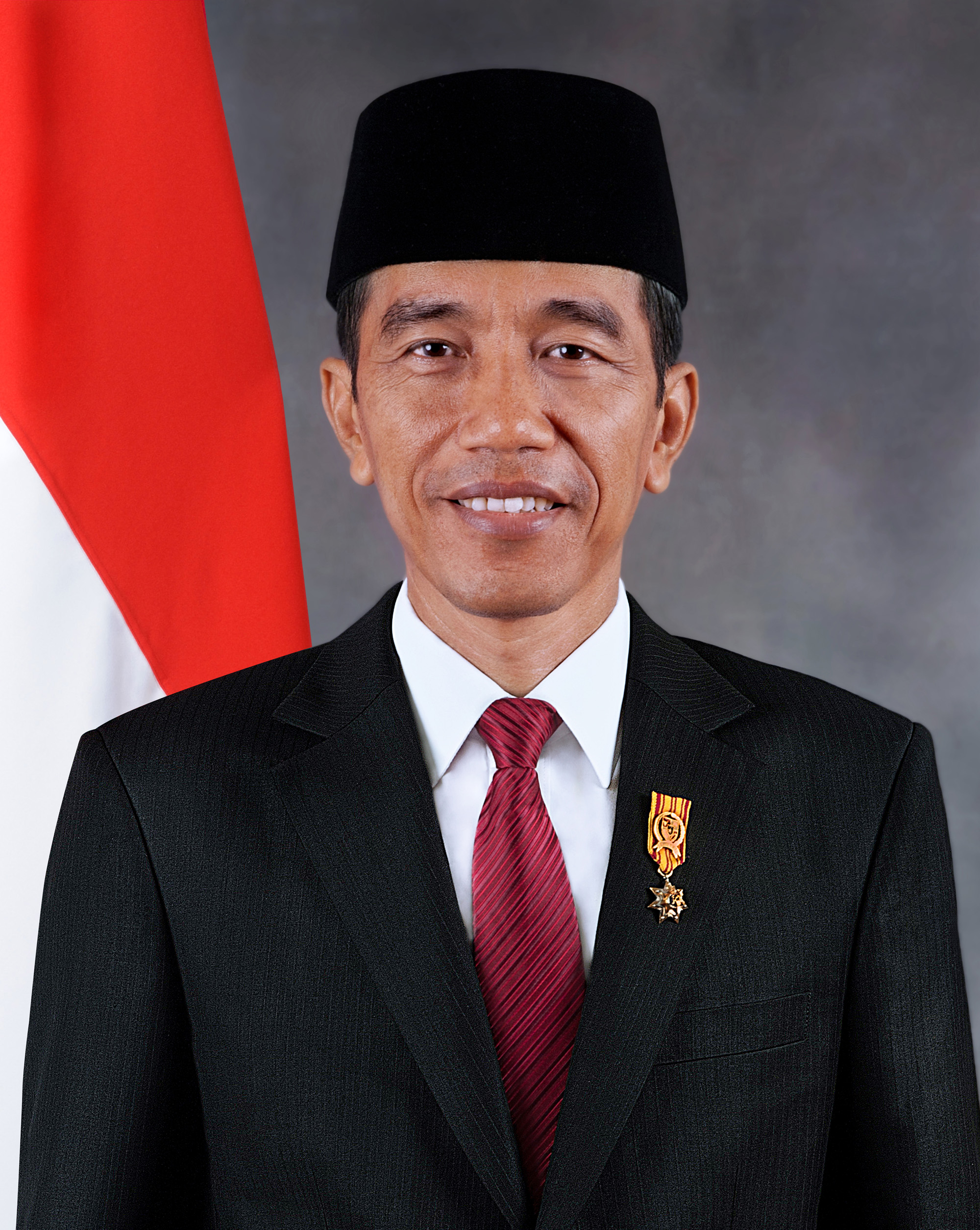
1961
Joko Widodo, or often called Jokowi, was born in Surakarta, Central Java, on June 21, 1961 to Widjiatno Notomihardjo and Sujiatmi. His father worked as a wood and bamboo seller. Together with his mother, his father then pursued the wood business, such as making furniture and furnishings. As a child, the first of four siblings often helped his parents to meet daily needs and school fees.
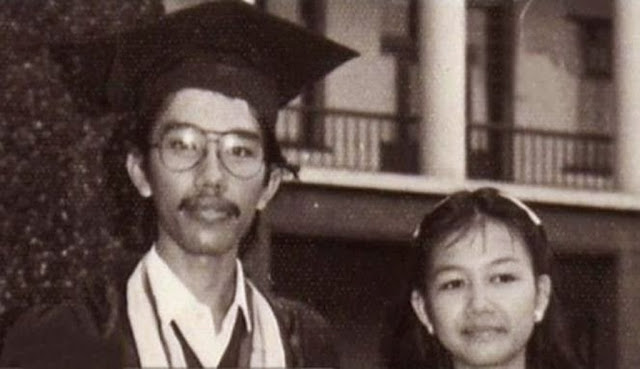
1986
Jokowi completed his elementary and high school education in Surakarta. Then, he continued his studies at the Faculty of Forestry, Gadjah Mada University, Yogyakarta. During college, he was active in nature lover activities. After graduating in 1985, Jokowi worked at the state-owned company PT Kertas Kraft Aceh. He was assigned to the Merkusii Pine Forest, Gayo Highlands, Central Aceh. Because he could not stand it, especially since his wife was seven months pregnant at the time, he resigned. He then worked at CV Roda Jati, his uncle's wood business named Miyono.
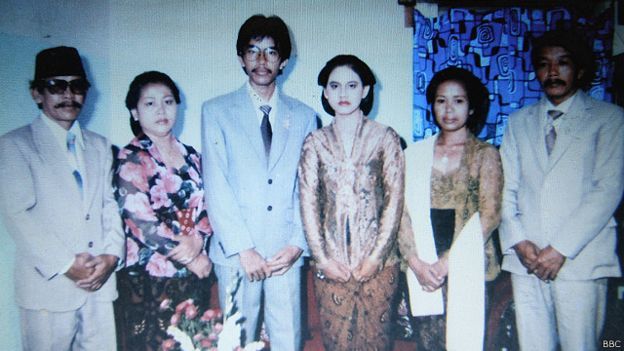
1986
Jokowi married Iriana, a girl he had dated since college, in 1986. The two met when Iriana often played with Jokowi's younger sister, Iit Sriyanti. At that time, Jokowi was studying at UGM, and Iriana was studying in high school. When they married, Iriana was a student at Muhammadiyah University in Surakarta. Later, the couple was blessed with three children.
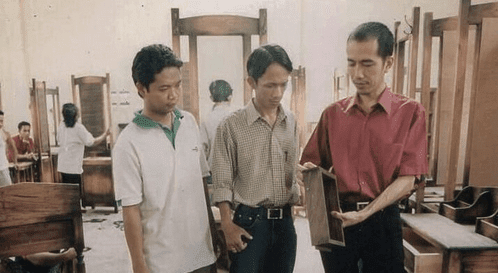
1988
In 1988, Jokowi decided to quit working at CV Roda Jati, his uncle's wood business. Although his uncle had forbidden him, Jokowi's decision was final. After that, he opened his own business under the name CV Rakabu, which was taken from the name of his first child. His business did not go smoothly. He was recorded as having been deceived when doing business with people, and lost Rp. 60 million in the 1990s.

1990
Three years of ups and downs and meeting domestic demand, Jokowi's business then expanded into the international market. The first international buyers came directly to Solo to see the results of his business products, and then ordered to be sent to Singapore and Taiwan. After that, his products became increasingly popular in almost all continents, even participating in exhibitions everywhere. As his business grew, he traveled around Europe, and witnessed the city planning there. Later, this experience became an inspiration for him to build Surakarta.
1994
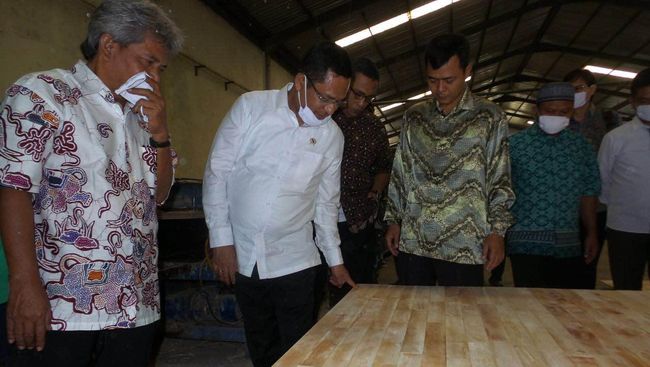
In mid-1994-1996, furniture exports boomed. The implication was that Jokowi's business also experienced success, including building business relations at home and abroad. Later, his business, which was originally only one factory, grew to eight factories, and from three employees to 1,200 employees. When he was elected as Mayor of Surakarta, he handed over his business to his family.

2005
In 2005, Jokowi was supported by PDI-P and PKB to compete in the Surakarta Pilkada. After successfully emerging as the winner, he made various innovations in changing the face of the city, from introducing the Batik Solo Trans bus to relocating street vendors humanely. Thanks to his various breakthroughs, he was re-elected as Mayor of Surakarta convincingly in 2010, with votes exceeding 90%.

2011
Jokowi received media attention in 2011. The reason was, he was involved in a conflict with the Governor of Central Java, Bibit Waluyo, regarding the former Saripetojo Ice Factory in the Purwosari area, Solo City. The plan was for the factory land to be turned into a shopping center (mall). Because the location was a cultural heritage and had to be preserved, Jokowi rejected it. Even though he received negative comments from Bibit Waluyo, Jokowi did not think too much about it, and remained firm in his stance.
2012
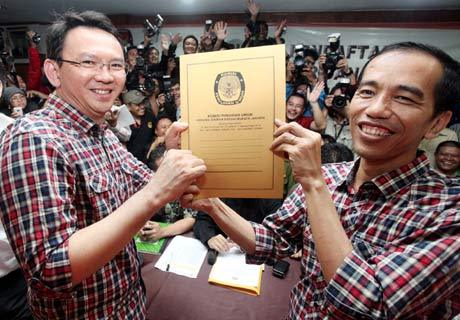
Not even two years into his second term as Mayor of Surakarta, Jokowi was nominated by the PDI-P to become the Governor of DKI Jakarta in 2012, paired with Basuki Tjahaja Purnama who was then a Gerindra cadre. At that time, the DKI Jakarta gubernatorial election was contested by several names of figures and politicians whose work was already well-known to the public, such as Fauzi Bowo, Hidayat Nur Wahid, Alex Noordin, Faisal Basri, and Hendardji Soepandji. The Jokowi-Ahok duo eventually emerged as the winner of the DKI Jakarta gubernatorial election.

2014
The public discussed the possibility of Jokowi in enlivening the presidential candidate market. Although his chances of winning the 2014 presidential election were estimated to be quite large, Jokowi was hampered by political vehicles. The reason was, the General Chair of PDI-P Megawati at that time was predicted to run in the presidential election. It was only on March 14, 2014, that Megawati appointed Jokowi as the presidential candidate from her party, and Jokowi also expressed his willingness. Paired with Jusuf Kalla, the former Vice President of Indonesia, Jokowi managed to defeat Prabowo Subianto, who was paired with Hatta Rajasa.
2017
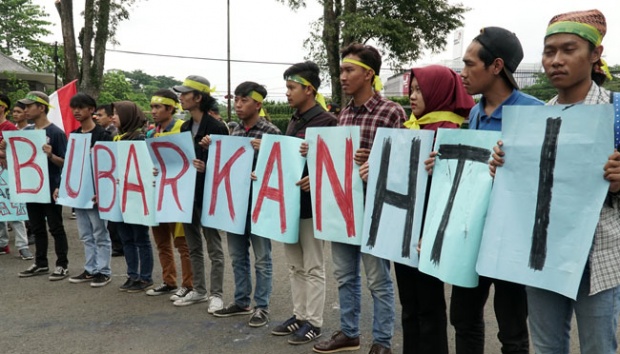
The government through the Ministry of Law and Human Rights (HAM) has officially revoked the status of the Hizbut Tahrir Indonesia (HTI) organization. The dissolution of HTI, among other things, cannot be separated from strong indications that the mass organization is in conflict with the goals, principles, and characteristics based on Pancasila and the 1945 Constitution, as regulated by Law No. 17 of 2003 concerning Community Organizations.

2019
In the 2019 presidential election, Jokowi again ran for president for a term of office until 2024. This time, he partnered with KH. Ma'ruf Amin, a senior cleric from the Nahdliyin. He again competed with Prabowo Subianto who partnered with Sandiaga Uno, who is known to the public as a businessman. In the election, Jokowi managed to retain his position as president.
2020
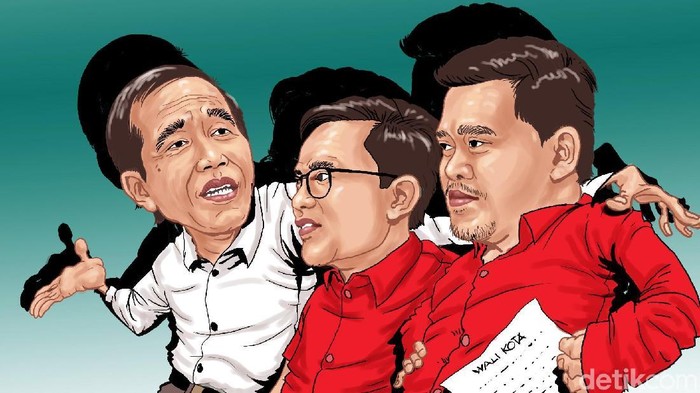
In his second term, Jokowi has been in the spotlight for his son and son-in-law's candidacy in the Surakarta and Medan regional elections, which were seen as an attempt to create a new political dynasty in Indonesia. On the other hand, Jokowi-Ma'ruf are now being tested by the Covid-19 pandemic.
 English
  Indonesian